Order before 12 PM EST today for rush handling · $150 regular / $250 rush

Apostille vs Embassy Legalization for Immigration
Learn the difference between apostille and embassy legalization for immigration. Find out which process you need and avoid document rejection.
Apostille MA
12/20/20252 min read
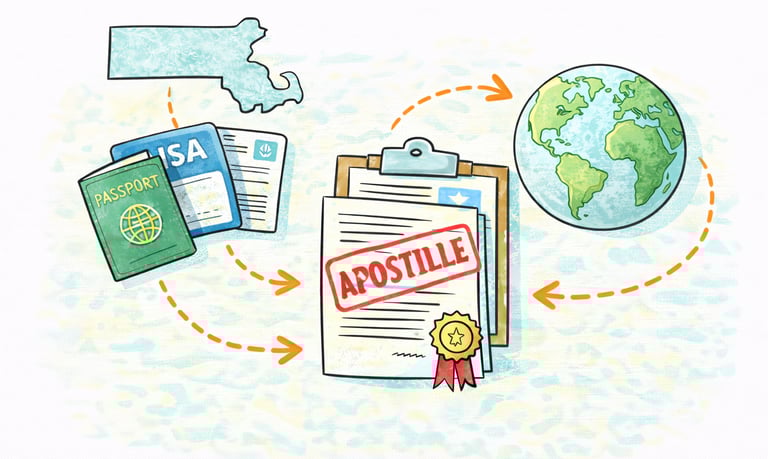
Apostille vs Embassy Legalization for Immigration
One of the most common points of confusion in immigration cases is whether a document needs an apostille or embassy legalization. Submitting the wrong type of authentication can lead to document rejection, processing delays, and additional costs.
This guide explains the difference between apostille and embassy legalization for immigration, how to determine which one you need, and how the process works for documents issued in Massachusetts.
What Is an Apostille
An apostille is an official certificate issued under the Hague Apostille Convention. It confirms that a public document issued in one country is authentic and legally valid for use in another Hague Convention country.
An apostille verifies:
The authenticity of the signature
The validity of the seal or stamp
The authority of the issuing office or notary
For Massachusetts documents, apostilles are issued by the Massachusetts Secretary of the Commonwealth.
What Is Embassy Legalization
Embassy legalization is a multi-step authentication process required for countries that are not part of the Hague Apostille Convention.
This process typically includes:
State authentication
Federal authentication
Legalization by the destination country’s embassy or consulate
Embassy legalization is more complex and time-consuming than an apostille.
Apostille vs Embassy Legalization Key Differences
Apostille applies only to Hague Convention countries.
Embassy legalization applies to non-Hague countries.
Apostille is usually a single certification step.
Embassy legalization involves multiple government authorities.
Apostille processing is generally faster.
Embassy legalization usually takes longer.
Apostille does not involve embassies.
Embassy legalization requires consular approval.
How to Know Which One You Need for Immigration
The determining factor is where the document will be used, not the type of document or the type of visa.
If the destination country is a Hague Convention member, an apostille is usually sufficient.
If the destination country is not a Hague member, embassy legalization is required.
Submitting an apostille when embassy legalization is required is one of the most common reasons immigration documents are rejected.
Immigration Documents Affected by Apostille or Legalization
Immigration authorities commonly require authentication for:
Birth certificates
Marriage certificates
Divorce decrees
Educational records
Affidavits
Powers of attorney
Background checks
Most private documents must be notarized before apostille or legalization.
Notarization and Immigration Documents
Many immigration-related documents require notarization before they can be apostilled or legalized.
Examples include:
Affidavits
Declarations
Consent letters
Personal statements
For notarization prior to apostille or legalization, a trusted local notary resource is:
https://middlesexnotary.com/
Apostille or Legalization Process Step by Step
Step 1 Confirm Destination Country Requirements
Determine whether the destination country accepts apostilles or requires embassy legalization. This step determines the entire process.
Step 2 Prepare the Correct Document Format
Public records must be certified copies.
Private documents must be properly notarized.
Photocopies are not accepted unless officially certified.
Incorrect format is the most common cause of rejection.
Step 3 Complete Apostille or Authentication
For Hague countries, documents are submitted for apostille at the state or federal level.
For non-Hague countries, documents proceed through state authentication, federal authentication, and embassy legalization.
Common Mistakes in Immigration Authentication
Submitting apostilles for non-Hague countries
Skipping required federal authentication
Using uncertified or short-form documents
Incorrect notarization wording
Assuming all countries follow the same rules
These mistakes often cause delays of weeks or months.
When This Difference Matters Most
Understanding the difference between apostille and embassy legalization is critical for:
Immigration and visa applications
Citizenship and residency cases
Marriage and family reunification
Employment abroad
Study abroad programs
Choosing the wrong process can invalidate documents entirely.
Final Thoughts
Knowing whether you need an apostille or embassy legalization is essential for successful immigration processing. The correct choice depends on the destination country and proper document preparation.
This guide provides clear informational guidance so immigration applicants can avoid common errors and delays.