

- Africa (37)
- Middle East (9)
- Asia (12)
- Americas and the Caribbean (2)
- Oceania and the Pacific (6)
- No longer non-Hague
- What to do instead
What “non-Hague country” means
A non-Hague country is one that has not joined the 1961 Hague Convention Abolishing the Requirement of Legalisation for Foreign Public Documents. It will not accept an apostille as proof that a U.S. signature is genuine. It wants its own embassy or consulate to confirm the document instead, which is called legalization.
This list contains every UN member state that is not a contracting party, derived from the HCCH status table (last updated 30 June 2026, checked 2 November 2026). Each region is alphabetical. For the countries that do accept apostilles, use the Hague apostille country list.
Non-Hague countries in Africa (37)
- Angola
- Benin
- Burkina Faso
- Cameroon
- Central African Republic
- Chad
- Comoros
- Congo (Republic of the)
- Côte d’Ivoire
- Democratic Republic of the Congo
- Djibouti
- Egypt
- Equatorial Guinea
- Eritrea
- Ethiopia
- Gabon
- Gambia
- Ghana
- Guinea
- Guinea-Bissau
- Kenya
- Libya
- Madagascar
- Mali
- Mauritania
- Mozambique
- Niger
- Nigeria
- Sierra Leone
- Somalia
- South Sudan
- Sudan
- Tanzania
- Togo
- Uganda
- Zambia
- Zimbabwe
Algeria (9 July 2026), Rwanda (5 June 2024) and Senegal (23 March 2023) left this list recently. Morocco, Tunisia, South Africa, Namibia, Botswana, Liberia and others are long-standing members.
Non-Hague countries in Middle East (9)
- Iran
- Iraq
- Jordan
- Kuwait
- Lebanon
- Qatar
- Syria
- United Arab Emirates
- Yemen
Saudi Arabia, Bahrain, Oman and Israel are Hague members, so they are not on this list. Saudi Arabia joined on 7 December 2022.
Non-Hague countries in Asia (12)
- Afghanistan
- Bhutan
- Cambodia
- Laos
- Malaysia
- Maldives
- Myanmar
- Nepal
- North Korea
- Sri Lanka
- Timor-Leste
- Turkmenistan
- Thailand until 28 Feb 2027
Non-Hague countries in Americas and the Caribbean (2)
- Cuba
- Haiti
Non-Hague countries in Oceania and the Pacific (6)
- Kiribati
- Micronesia
- Nauru
- Papua New Guinea
- Solomon Islands
- Tuvalu
Also outside the Convention, but not UN members: Taiwan, the State of Palestine and the Holy See (Vatican City).
Countries removed from the non-Hague list
If you are working from an old list, these countries have since joined the Convention and now accept apostilles. Using embassy legalization for them is no longer needed, and some will no longer do it.
| Country | Accepts apostilles from |
|---|---|
| Vietnam | 11 Sep 2026 |
| Algeria | 9 Jul 2026 |
| Bangladesh | 30 Mar 2025 |
| Rwanda | 5 Jun 2024 |
| Canada | 11 Jan 2024 |
| China (mainland) | 7 Nov 2023 |
| Senegal | 23 Mar 2023 |
| Pakistan | 9 Mar 2023 |
| Saudi Arabia | 7 Dec 2022 |
| Indonesia | 4 Jun 2022 |
| Singapore | 16 Sep 2021 |
| Thailand (coming) | 28 Feb 2027 |
What to do instead of an apostille
For a non-Hague country, a U.S. document goes through a legalization chain. For a Massachusetts document, it usually looks like this:
- Get the right original. A certified copy with an original Massachusetts official’s signature, or a document notarized by a Massachusetts notary. Same rules as an apostille; photocopies don’t work.
- State certification. The Secretary of the Commonwealth in Boston issues a certification instead of an apostille ($6 per document) when the form names a non-Hague country.
- U.S. Department of State authentication. Most embassies in Washington want the federal Office of Authentications to certify the state’s certificate ($20 per document). Federal documents, like FBI checks, start here.
- Embassy or consulate legalization. The destination country’s embassy or consulate stamps the document. Each sets its own fees, forms and timing, and some require a translation first.
- Sometimes, a final step abroad. Several Gulf countries, including the UAE and Qatar, commonly require the document to be attested again by their foreign ministry after it arrives.
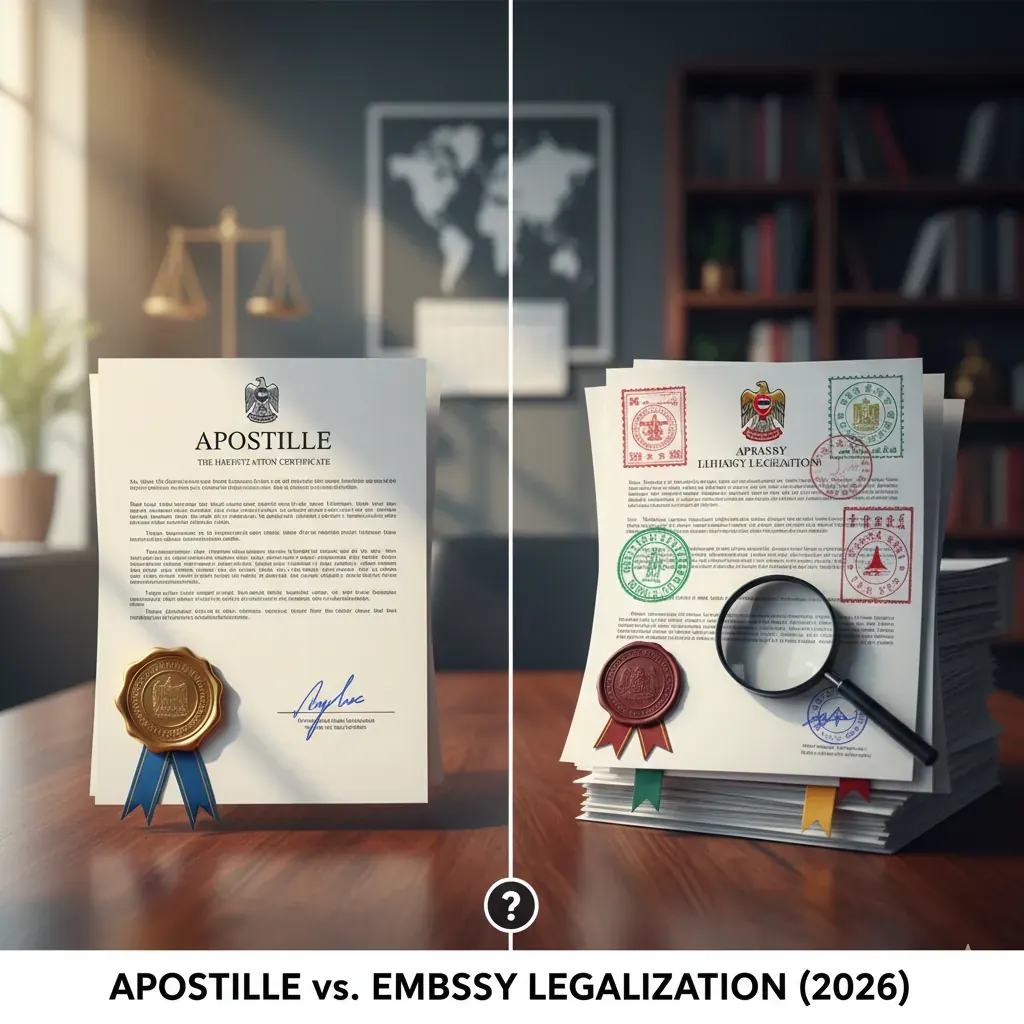
Embassy requirements change without much notice: an extra form, a new fee, a copy of your passport, an appointment system. We confirm the current requirements with each embassy before filing. The full process is on our embassy legalization page.
The non-Hague countries we handle most
| Country | Typical documents | Note |
|---|---|---|
| United Arab Emirates | Degree certificates, birth and marriage certificates, powers of attorney, company documents | Usually attested again by the UAE Ministry of Foreign Affairs after arrival |
| Qatar | Degrees and transcripts for work permits, marriage and birth certificates | Embassy legalization, then attestation in Qatar is common |
| Kuwait | Degrees, marriage certificates, police certificates | Embassy legalization after Department of State |
| Egypt | Birth, marriage and divorce records, powers of attorney | Arabic translation often requested |
| Jordan, Lebanon, Iraq | Powers of attorney, civil records, school documents | Requirements vary by consulate |
| Nigeria, Ghana, Kenya | Powers of attorney, affidavits, academic records | Embassy legalization after Department of State |
| Malaysia, Sri Lanka | Academic records, marriage certificates | Embassy legalization after Department of State |
The receiving authority decides what it accepts. These notes are what we commonly see, not legal advice; confirm with the office that asked for the document.
Hague and non-Hague countries: how to tell in 10 seconds
- Country on this page → certification + embassy legalization.
- Country on the Hague list → apostille, nothing more.
- Federal document (FBI, USCIS, IRS) → U.S. Department of State either way; see FBI apostille.
- Document from another U.S. state → that state’s office, not Massachusetts.
Getting the route wrong costs weeks: an apostille issued for a non-Hague country is simply refused. Tell us the country when you order, and we file for the right certificate. Our Massachusetts apostille service handles the state step; prices are on Massachusetts apostille cost; embassy legalization is quoted after we review your documents, so you see the price before you order.