

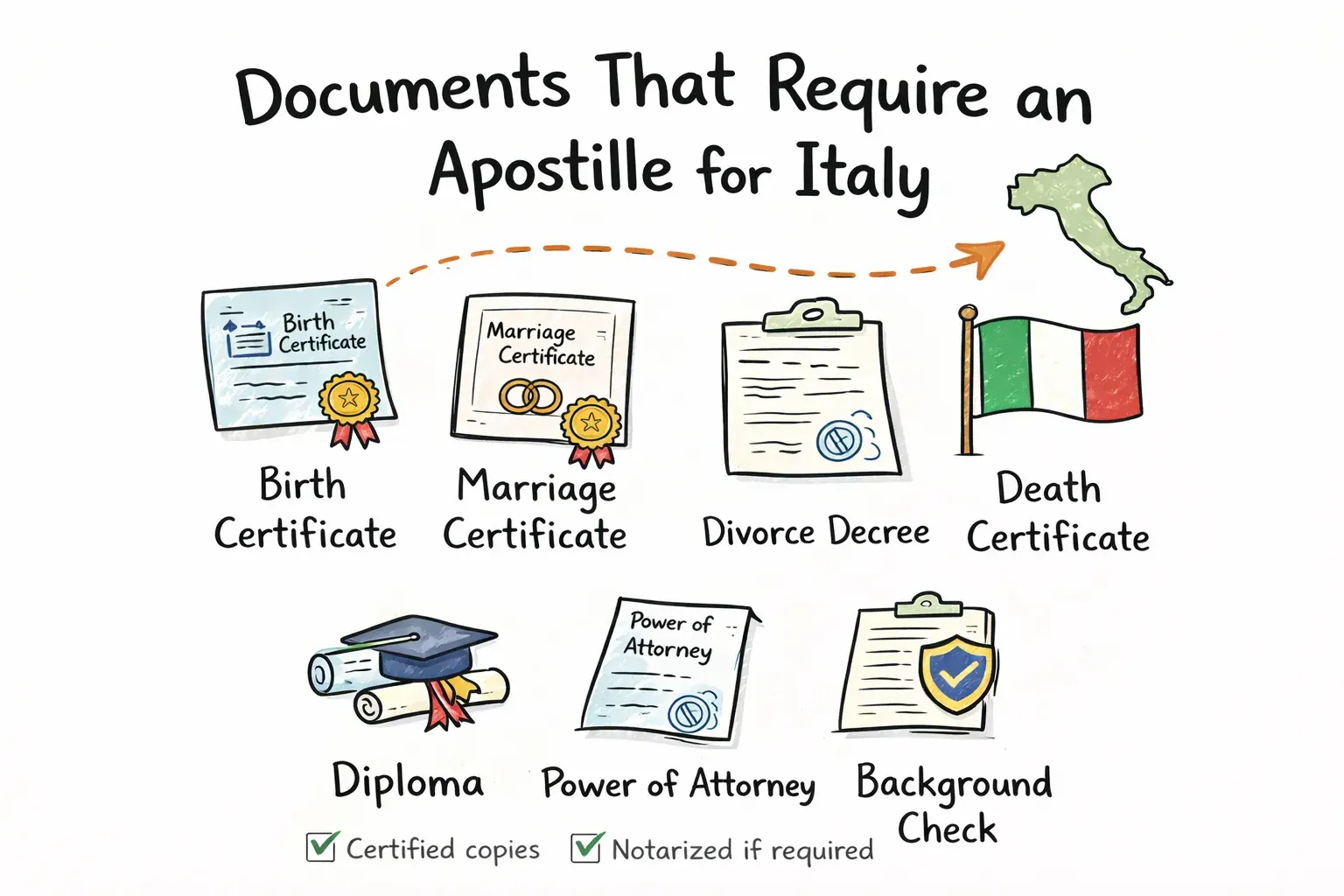
Apostille meaning in plain English
An apostille is proof, for a foreign official, that a document’s signature is real. A clerk in Rome has no way to check whether a Boston town clerk or a Woburn notary is genuine. The apostille does that for them. The issuing authority checks the signature against its records, then attaches a standard certificate that every member country recognizes.
The word is French and means a note added to a document. The legal meaning comes from the Convention of 5 October 1961 Abolishing the Requirement of Legalisation for Foreign Public Documents, usually called the Apostille Convention. It entered into force on 24 January 1965. As of November 2026 it has 130 contracting parties, 129 of them in force (Thailand joins on 28 February 2027).
What an apostille certifies, and what it does not
An apostille certifies three things and nothing else:
- The signature on the document is authentic.
- The person who signed acted in that capacity (for example, as a notary or a city clerk).
- The seal or stamp on the document belongs to that person or office.
It does not confirm that the content is true, that the document is the right one for your purpose, or that the receiving office will accept it. Those decisions belong to the receiving country.
What an apostille looks like
Every apostille follows the same model, set out in the Convention’s annex. It is headed “Apostille (Convention de La Haye du 5 octobre 1961)” and has ten numbered fields:
- Country (where the apostille is issued, e.g. United States of America)
- Has been signed by (the notary or official)
- Acting in the capacity of (notary public, town clerk…)
- Bears the seal/stamp of
- At (city where certified)
- The (date)
- By (the issuing authority)
- No. (a unique number)
- Seal/stamp of the authority
- Signature of the issuing official
In Massachusetts it is a single page, signed and sealed by the Secretary of the Commonwealth, and attached to your document. Keep the two together: if you remove the staple, the apostille no longer proves anything about the document. Some countries now issue electronic apostilles and keep online registers so the receiver can check the number.
Who issues apostilles in the United States
Who issues the apostille depends on who signed the document, not where you live.
| Document signed by | Apostille issued by | Example |
|---|---|---|
| A state or local official, or a notary commissioned in that state | That state’s Secretary of State (in Massachusetts, the Secretary of the Commonwealth) | Massachusetts birth certificate, Massachusetts-notarized power of attorney |
| A federal official or agency | U.S. Department of State, Office of Authentications ($20 per document) | FBI background check, USCIS or IRS letter |
A state cannot apostille another state’s documents, and it cannot apostille federal documents. Massachusetts, for example, certifies only the original signatures of a Massachusetts notary, justice of the peace, city or town clerk, court clerk, or the Registrar of Vital Records. Its fee is $6 per document. The step-by-step process is in how to get an apostille in Massachusetts.
Apostille vs notarization vs certification vs legalization
These four words get mixed up all the time. They are different steps, and many documents need two of them.
| What it is | Who does it | Used for | |
|---|---|---|---|
| Notarization | A notary confirms the identity of the signer (or that a copy is true) | A notary public | Private documents, before any apostille |
| Apostille | One certificate confirming the signature and seal, accepted by all Convention members | State Secretary of State or U.S. Department of State | Hague Convention countries |
| Certification (authentication) | Same check as an apostille, but in a non-Convention format | The same offices | First step for non-Hague countries |
| Legalization | The destination country’s embassy or consulate confirms the certification | Foreign embassy or consulate | Non-Hague countries, after certification |
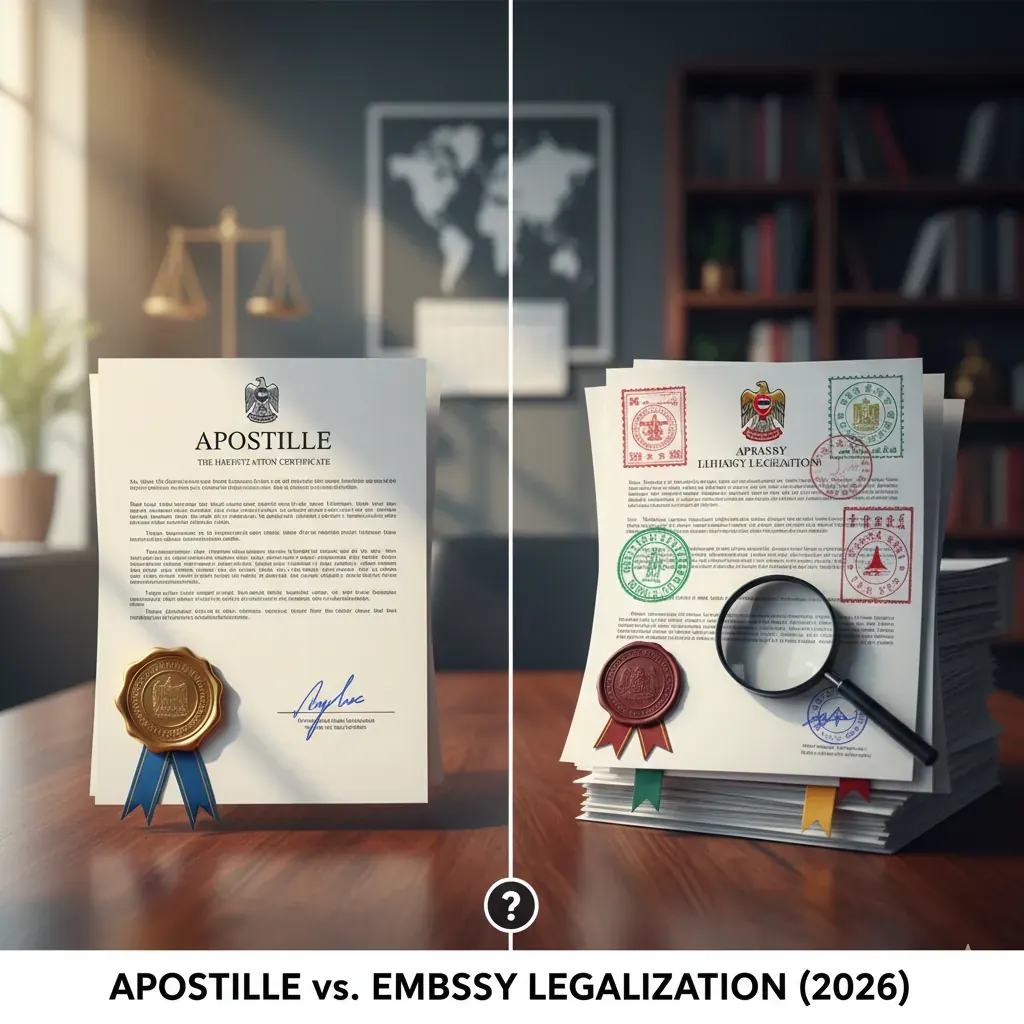
A typical private document headed to Spain goes: notarization → apostille. The same document headed to the UAE goes: notarization → state certification → further authentication → UAE embassy legalization. We explain the second route on embassy legalization.
When you need an apostille
You need an apostille when a foreign authority asks for an official U.S. document and that country is in the Convention. The most common reasons we see:
- Citizenship by descent: Italian, Polish, Lithuanian, Portuguese and other ancestry claims (birth, marriage, death and naturalization records).
- Residence and work visas: Spain, Portugal and others ask for an apostilled FBI background check; Korea and China for diplomas and background checks.
- Marriage abroad: birth certificate, single-status statement, divorce judgment.
- Study abroad: diplomas and transcripts.
- Property, inheritance and banking abroad: powers of attorney and affidavits.
- Business: certificates of good standing, articles of organization, board resolutions.
- Adoption and family matters: home studies, court decrees, medical letters.
You do not need an apostille for documents used inside the U.S., or (usually) when a foreign embassy’s own notary or consular officer handles the signing. When in doubt, ask the receiving office what it wants in writing.
What are apostille services?
Apostille services are private businesses that get the apostille for you. The government still issues it; the service does the legwork: checking that the document qualifies, notarizing it if needed, completing the request form, paying the government fee, standing in line or tracking the mail, and shipping the finished document back or abroad.
What a good apostille service does that you can’t easily do yourself:
- Checks the document before filing, so it isn’t sent back for a photocopied signature or the wrong certificate type.
- Files in person, which is often days or weeks faster than mailing.
- Routes federal documents to the U.S. Department of State and non-Hague documents through embassy legalization.
- Coordinates translation and delivery to the consulate, lawyer or office abroad.
What it can’t do: issue an apostille itself, apostille a document from another state through the wrong office, or guarantee what a foreign authority will accept. Be wary of anyone who calls their service “official”. We are a private Massachusetts company, not a government agency and not a law firm.
Our prices for Massachusetts documents start at $99 per document (7–10 business days), with express $149, next business day $199 and same day $249. The $6 Massachusetts fee is included at every speed. An FBI background check apostille starts at $185. Return shipping has fixed prices, and you see the full total before you place the order. Full details: Massachusetts apostille cost.
How to get an apostille, in short
- Find out whether the destination country is in the Hague Convention.
- Get the right version of the document: a certified copy with an original official signature, or a properly notarized original.
- Send it to the authority for the state that issued it, or to the U.S. Department of State for federal documents.
- Add a translation if the receiving country requires one.
For Massachusetts documents, follow our step-by-step Massachusetts guide, or order online and we handle it.