Order before 12 PM EST today for rush handling · $150 regular / $250 rush

Apostille vs Embassy Legalization: What’s the Difference? (2026)
Confused between apostille and embassy legalization? Learn the exact difference, which countries need what, and how to avoid document rejection in 2026.
Apostille MA
1/30/20263 min read
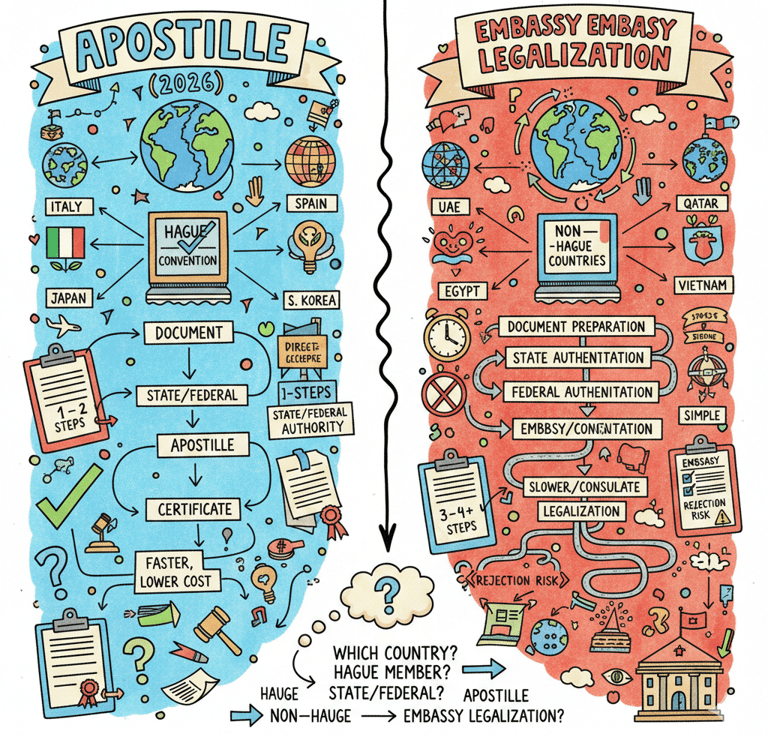
Apostille vs Embassy Legalization: What’s the Difference? (2026)
If you’re preparing documents for use outside the United States, you’ll almost always face one critical question:
Do I need an apostille, or do I need embassy legalization?
Choosing the wrong process can get your documents rejected, delay visas, block international jobs, or stall overseas business. This guide explains the exact difference, how to choose the correct method in 2026, and how to avoid the most common mistakes.
What Is an Apostille?
An apostille is a simplified form of international document authentication used only between countries that are members of the Hague Apostille Convention.
The apostille certifies:
The authenticity of the signature
The capacity of the signer
The validity of the seal or stamp
Once issued, the document is accepted directly in another Hague member country without further embassy involvement.
In the United States, apostilles are issued by:
State authorities (for state-issued or notarized documents)
The U.S. Department of State (for federal documents)
What Is Embassy Legalization?
Embassy legalization (also called consular legalization) is required when the destination country is not a member of the Hague Apostille Convention.
This process is longer and involves multiple authentication steps, ending with legalization by the destination country’s embassy or consulate.
Embassy legalization verifies the document through layers of government approval, rather than a single apostille certificate.
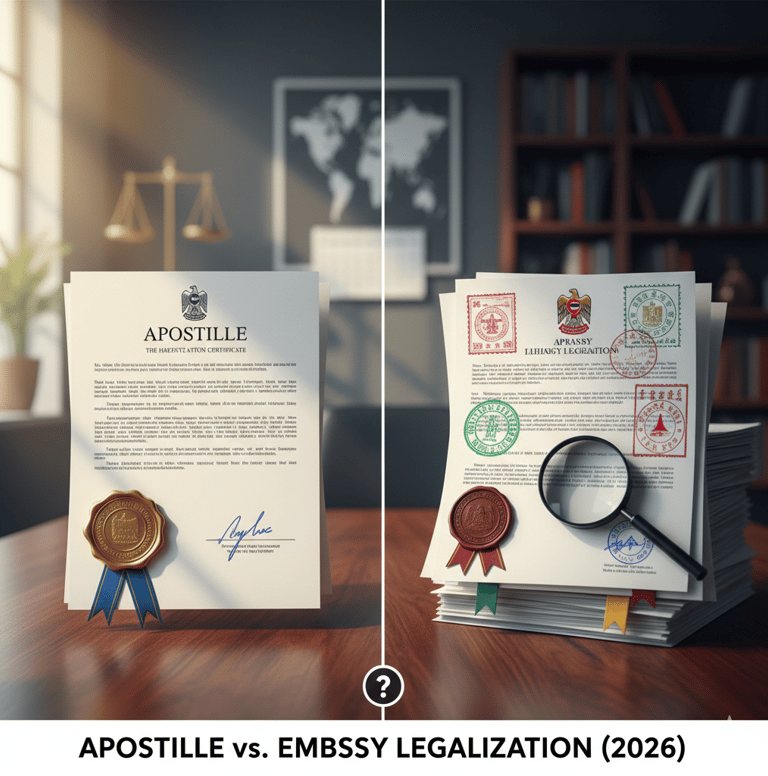
Apostille vs Embassy Legalization: Key Differences
Apostille
Used for: Hague Convention countries
Governing treaty: Hague Apostille Convention
Embassy involvement: No
Processing steps: 1–2 steps
Time required: Faster
Cost: Lower
Rejection risk: Low (when prepared correctly)
Embassy Legalization
Used for: Non-Hague countries
Governing treaty: No international treaty
Embassy involvement: Yes
Processing steps: 3–4 or more steps
Time required: Slower
Cost: Higher
Rejection risk: Higher if any step is missed
Apostille vs Embassy Legalization Comparison
Apostille
✅ Hague Convention countries
✅ No embassy required
✅ Faster processing
✅ Lower cost
✅ Fewer steps
Embassy Legalization
❌ Not Hague countries
❌ Embassy involvement required
❌ Longer processing time
❌ Higher cost
❌ Multiple authentication steps
Best if you want visual clarity without tables.
Which Countries Need an Apostille?
If the destination country is a Hague Convention member, an apostille is usually sufficient.
Examples include:
Italy
Spain
France
Germany
Japan
South Korea
You can see the full, updated list on our
Hague Apostille Country List page.
Which Countries Require Embassy Legalization?
If the destination country is not a Hague member, apostilles are not accepted. These countries require embassy legalization instead.
Common examples include:
United Arab Emirates (UAE)
Qatar
Egypt
Kuwait
Jordan
Vietnam (until its Hague entry is fully in force)
For a complete breakdown, see our
Non-Hague Countries List (2026) page.
Step-by-Step: How Embassy Legalization Works
Most non-Hague legalization cases follow this structure:
1) Document Preparation
Certified copies (birth, marriage, court records), or
Properly notarized originals
2) State Authentication
Issued by the state authority where the document originated
In Massachusetts, this is handled by the Massachusetts Secretary of the Commonwealth
3) Federal Authentication (If Required)
Many embassies require authentication by the U.S. Department of State
4) Embassy or Consulate Legalization
Final approval by the destination country’s embassy or consulate
Missing any one step can result in rejection.
Most Common Mistakes That Cause Rejection
These errors cause the majority of apostille and legalization failures:
Choosing apostille when embassy legalization is required
Using photocopies instead of certified documents
Improper notarization language
Sending documents to the wrong authority
Ignoring embassy-specific formatting rules
This is why many clients seek professional handling instead of trial-and-error submissions.
How to Know Which One You Need
Ask yourself three questions:
Which country will use the document?
Is that country a Hague member?
Is the document state-issued or federal?
If the country is Hague → apostille
If the country is a non-Hague → embassy legalization
If you’re unsure, verifying before submission saves weeks of delay.
Frequently Asked Questions
What happens if I use an apostille for a non-Hague country?
The document will usually be rejected and must be redone through embassy legalization.
Is embassy legalization always required for non-Hague countries?
In most cases, yes. Some embassies have limited exceptions, but legalization is the standard requirement.
Can the same document be apostilled and legalized?
No. The process depends entirely on the destination country. Only one path applies.
Which process is faster?
Apostille is almost always faster than embassy legalization.