

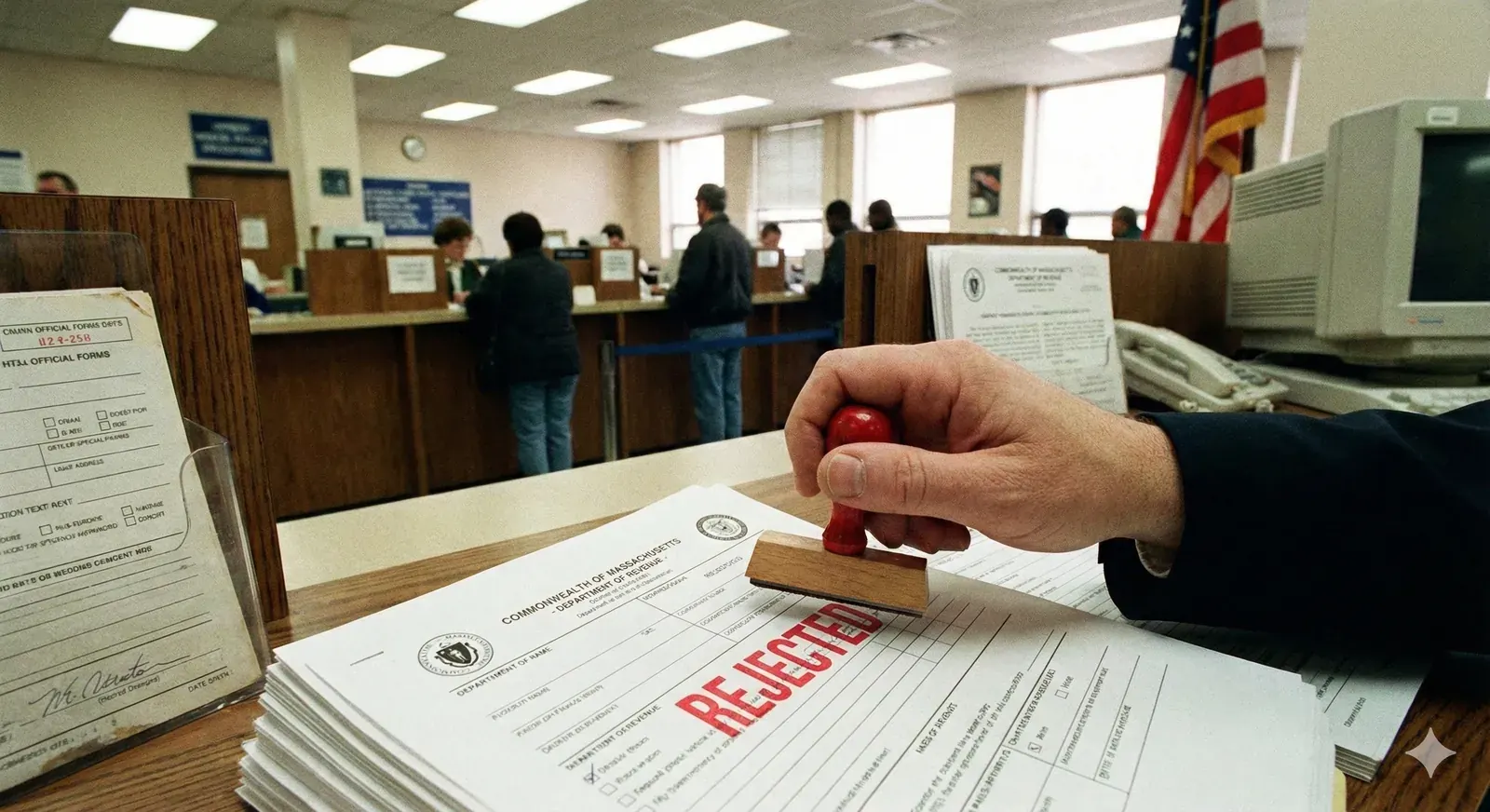
Two kinds of apostille rejection
An apostille can be rejected at two points, and the fix is different for each:
- Before it is issued: the Secretary of the Commonwealth won’t certify the signature. Your request comes back with no apostille. This is usually about who signed and how.
- After it is issued: the consulate, court or registry abroad won’t accept the apostilled document. This is usually about the document version, translation or route.
Mistakes that get a request rejected in Massachusetts
1. Photocopied signatures and plain photocopies
Massachusetts certifies original signatures only. A photocopy of a birth certificate, a scan printed at home, or a copy where the clerk’s signature is reproduced can’t be apostilled. Fix: order a fresh certified copy from the issuing office, with an original signature. We can get a Massachusetts certified copy for you from $75.
2. Out-of-state notary or out-of-state document
The state can only certify Massachusetts notaries, justices of the peace, city and town clerks, court clerks and the Registrar of Vital Records. A Rhode Island notary or a New York birth certificate goes to that state. Massachusetts also can’t certify out-of-state school diplomas and transcripts. Fix: send it to the right state, or, for private documents, sign again in front of a Massachusetts notary.
3. An incomplete or incorrect notarial certificate
The Commonwealth checks the notarization before certifying it. Its own checklist: the notary signed exactly as commissioned; the seal is on the document and legible; the commission expiration date is correct and complete; the notarial certificate is fully filled in. A stamp with no certificate wording, a blank date or venue, or a seal that didn’t print will stop it. Fix: re-notarize with a complete Massachusetts certificate (acknowledgment, jurat, signature witnessing or copy certification).
4. A notarized copy of a government document
Notarizing a photocopy does not turn it into an original. The state’s request form says it does not authenticate notarized copies of federal, in-state or out-of-state government documents; its examples are a notarized photocopy of a Delaware certificate of good standing and of an FBI background check. Fix: use a certified copy from the issuing office (or, for federal records, the federal route).
5. The wrong office: state versus federal
FBI background checks and documents signed by federal officials (USCIS, IRS, federal courts) are authenticated by the U.S. Department of State, not by any state, for $20 per document. An FBI Identity History Summary must be the original issued by the FBI with the FBI official’s signature; it is not notarized and not apostilled by a state. Fix: send federal documents to the Department of State. See FBI background check apostille.
6. Form, fee and envelope errors on mailed requests
No destination country on the Apostille and Certification Authentication Form, the wrong check amount, a check not payable to “Commonwealth of Massachusetts”, or no prepaid return envelope will hold up a mailed request. The office says missing information can delay issuance. Fix: fill in every field, pay $6 per document, and enclose return postage. Step by step: how to get an apostille in Massachusetts.
Mistakes that get an apostilled document rejected abroad
7. The wrong country route: Hague versus non-Hague
An apostille is only valid in Hague Convention countries. If the document is going to the UAE, Qatar, Kuwait or Egypt, an apostille will be refused; those countries need a certification and embassy legalization. The reverse happens too: old advice to legalize for China, Canada or Saudi Arabia, which now accept apostilles. Fix: check the Hague list or the non-Hague list and write the country on the request.
8. Short-form or souvenir vital records
Many countries, Italy above all, want the long-form birth or marriage certificate that shows parents’ names. A short abstract, a hospital “souvenir” certificate or a wallet card won’t do. Fix: order the full certified copy from the town clerk or the Registry of Vital Records. See vital records apostille.
9. Old copies
The apostille itself doesn’t expire, but receiving offices often want a recently issued certificate or background check, typically within a few months. A certified copy from ten years ago may be refused even with a fresh apostille. Fix: ask the receiving office for its recency rule and order a new copy if needed.
10. Laminated, damaged or altered documents
A laminated certificate can’t have an apostille attached to it, and torn, taped or written-on documents are often refused as altered. Fix: order a new certified copy. Never laminate an original you might need abroad.
11. Missing or wrong translation
Many countries want the document and the apostille translated, often by a sworn or certified translator, and often after the apostille is attached. Translating first, or using a translator the country doesn’t recognize, can mean doing it twice. Fix: confirm the translation rule with the receiving office. We coordinate certified translation.
12. A separated apostille
The apostille is stapled to your document for a reason. If you remove the staple to copy or scan it, the receiving office may not accept that the two belong together. Fix: keep them together; copy with the staple in place.
What to do if your apostille was rejected
- Get the reason in writing. From the Massachusetts office, or from the office abroad.
- Identify which kind of rejection it is (before issue, or after) using the list above.
- Fix the underlying document: new certified copy, new notarization, the right office, or translation.
- Refile, and plan the time. By mail that is another two to three weeks; at the counter, the same visit for up to three documents. See processing times.
If the deadline is close, our same-day service ($249) files for you when up to three documents reach us by 11 AM ET, ready by 5 PM.
Pre-filing checklist
- Original signature of a Massachusetts notary or official (not a photocopy)
- Complete notarial certificate with a legible seal and expiration date, if notarized
- Certified copy issued by the office, not a notarized photocopy
- State document to the state; federal document to the U.S. Department of State
- Destination country confirmed as Hague or non-Hague
- Long-form and recent enough for the receiving office
- Not laminated, damaged or altered
- Translation plan agreed with the receiving office
How we stop rejections before they happen
Every document we file is checked by Ans before it goes to the counter: who signed, whether the signature and seal are original and complete, whether it belongs with the state or the federal government, and whether the country takes an apostille or needs legalization. If something is wrong, you hear about it before filing, with the fix. If the document needs a Massachusetts notarization, we do it for $30. Our Massachusetts apostille service costs $99 per document standard and $249 same day, state fee included; see pricing.