

Apostille vs legalization: what is the difference?
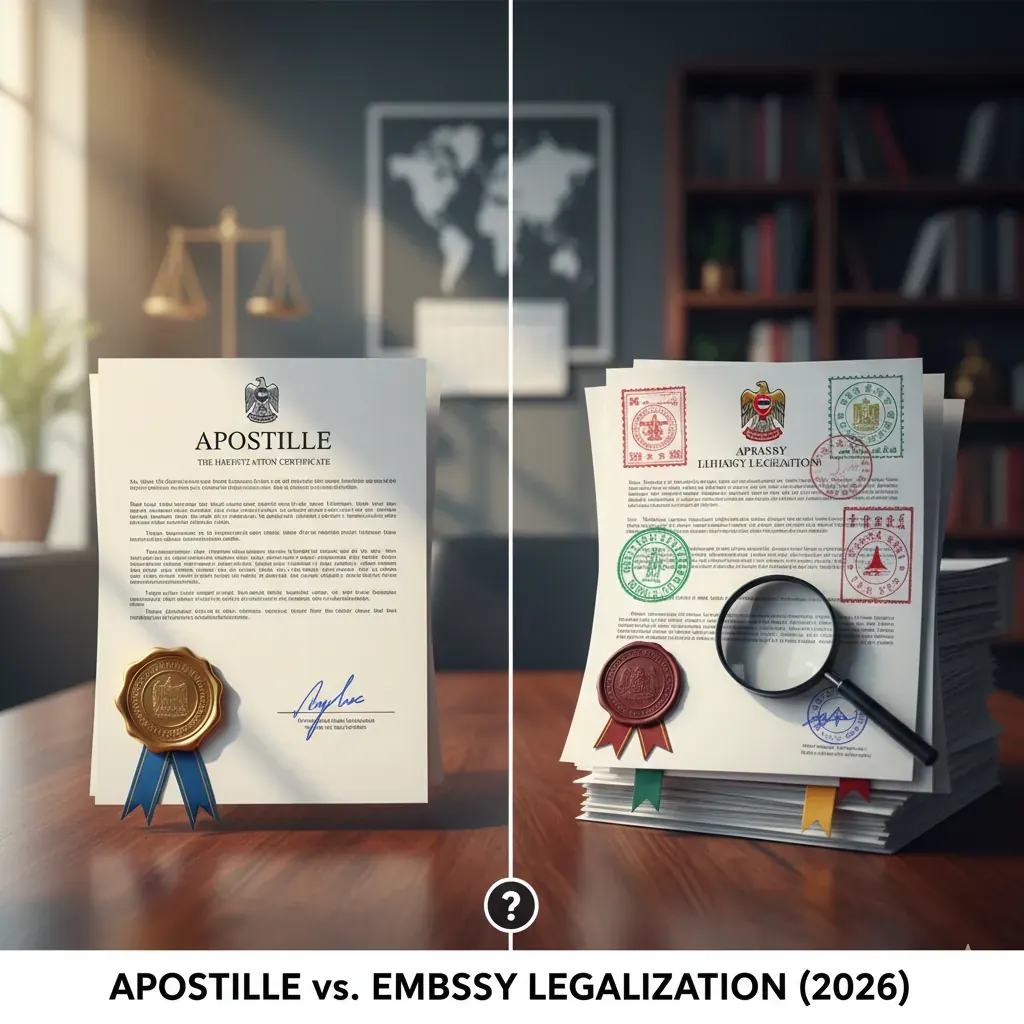
An apostille and legalization do the same job: they prove a U.S. signature is genuine so another country accepts the document. The difference is the number of steps. Hague Convention countries accept one apostille. Other countries want a chain of certificates that ends at their own embassy.
| Who issues it | When you need it | Government fee | |
|---|---|---|---|
| Apostille | Massachusetts Secretary of the Commonwealth (state documents) or U.S. Department of State (federal documents) | Destination is a Hague Convention country. This is the only step. | $6 state, $20 federal |
| Certification | Massachusetts Secretary of the Commonwealth | Destination is not a Hague country. Step one of legalization. | $6 |
| Authentication | U.S. Department of State, Office of Authentications | Required by many embassies after the state certification; always the first step for federal documents | $20 |
| Legalization | The destination country’s embassy or consulate in the U.S. | Final step for non-Hague countries | Set by each embassy |
Wrong certificate, wrong country: an apostille sent to the UAE embassy is refused, and a certification sent to Spain isn’t what Spain asked for. Always tell us the country first. More background in what is an apostille.
How embassy legalization works for Massachusetts documents
Embassy legalization for a Massachusetts document runs in a fixed order. Every step confirms the signature on the step before it.
- Get the document ready. Certified copies of vital records and court records are ready as issued. Private documents, such as a power of attorney, a degree copy or a company resolution, are first notarized by a Massachusetts notary ($30 with us).
- Massachusetts certification. We file it with the Commissions Section at One Ashburton Place, Boston, and ask for a certification rather than an apostille. The state charges $6.
- U.S. Department of State authentication, when the embassy requires it. The Office of Authentications confirms the Massachusetts certification; the government charges $20 per document. Federal documents, like an FBI background check, start here.
- Embassy or consulate legalization. The embassy checks the chain and adds its stamp or sticker. Some embassies take documents only from their consular jurisdiction or by appointment; we deal with that.
- Back to you, or straight abroad. Some countries add a final step after arrival, such as attestation by their foreign ministry. The authority asking for your document will tell you if so.
Which countries need legalization instead of an apostille
These countries are not parties to the Hague Apostille Convention, as of November 2026, checked against the HCCH status table. U.S. documents for them need embassy legalization:
- United Arab Emirates
- Qatar
- Kuwait
- Jordan
- Lebanon
- Iraq
- Egypt
- Nigeria
- Ghana
- Kenya
- Ethiopia
- Malaysia
- Sri Lanka
- Cambodia
- Taiwan
- Thailand (until 28 Feb 2027)
This is not the full list. See every country on our non-Hague countries list.
Recently switched to apostille: Saudi Arabia (December 2022), Pakistan (9 March 2023), China (7 November 2023), Canada (11 January 2024), Bangladesh (30 March 2025), Algeria (9 July 2026) and Vietnam (11 September 2026). Documents for these countries need only an apostille now. Thailand joins on 28 February 2027. Bahrain and Oman, often assumed to be non-Hague, also accept apostilles.
Document legalization for the UAE, Qatar, Kuwait and Egypt
These four are common destinations for U.S. documents that need legalization. The chain is the same for each, but every embassy has its own fees, forms and appointment rules, and they change. We confirm the current requirements when we quote.
United Arab Emirates
Common documents: degrees and transcripts for employment visas and equivalency, marriage and birth certificates for family residence, powers of attorney, and company documents for a UAE licence. Many UAE authorities also want attestation by the UAE Ministry of Foreign Affairs after arrival.
Qatar
Common documents: degree certificates for work visas, marriage and birth certificates for family residence, and corporate documents.
Kuwait
Common documents: diplomas and transcripts for employment, FBI background checks for residence, and personal records for family visas.
Egypt
Common documents: powers of attorney for property and inheritance, marriage and divorce records, and birth certificates.
How long embassy legalization takes
Embassy legalization takes longer than an apostille because there are more offices in the chain. The Massachusetts certification takes the same time as an apostille (processing times), and can be done same day. The federal step and the embassy step depend on those offices: some embassies return documents in a few days, others take several weeks, and holidays in either country add time. We give you a realistic estimate for your country with your quote, and update you at each step.
What legalization costs
Embassy legalization is quoted after we review your documents, not fixed-price, because the embassy fee depends on the country, the document type and sometimes its purpose. Your quote covers the full chain (the Massachusetts certification, U.S. Department of State authentication where needed, the embassy fee and our service) plus any translation, and you see the full price before you order. Return shipping is the same as for any order: FedEx Ground $25, DHL International $90 and other options on the order form. Our apostille prices are on the Massachusetts apostille cost page.